Wednesday, May 11, 2005

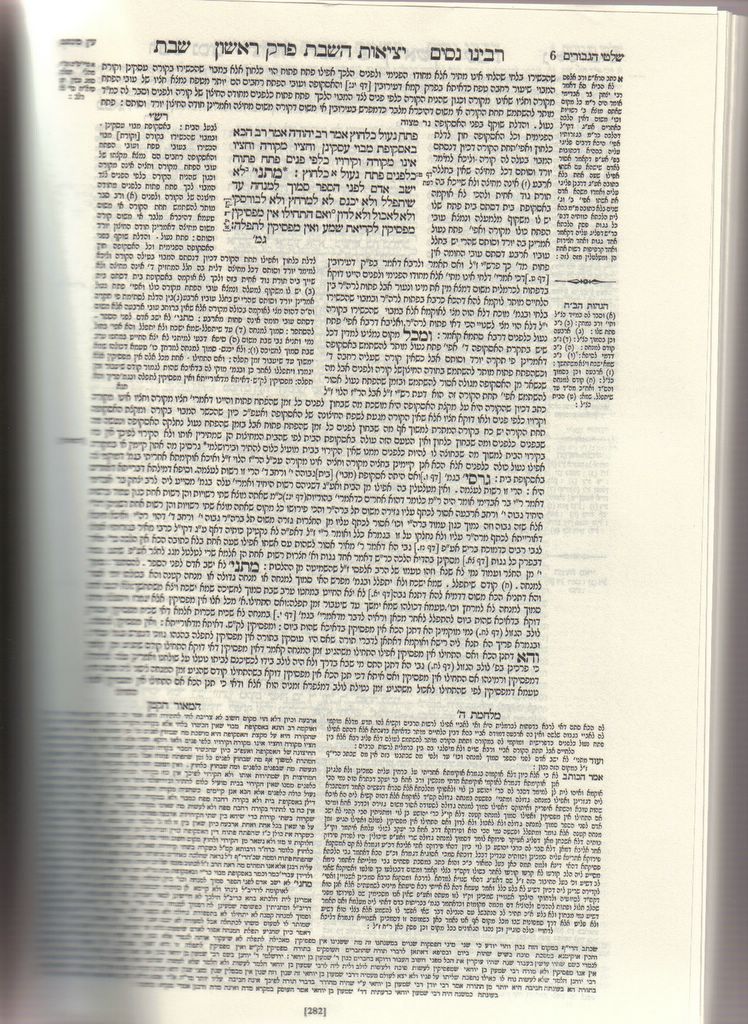
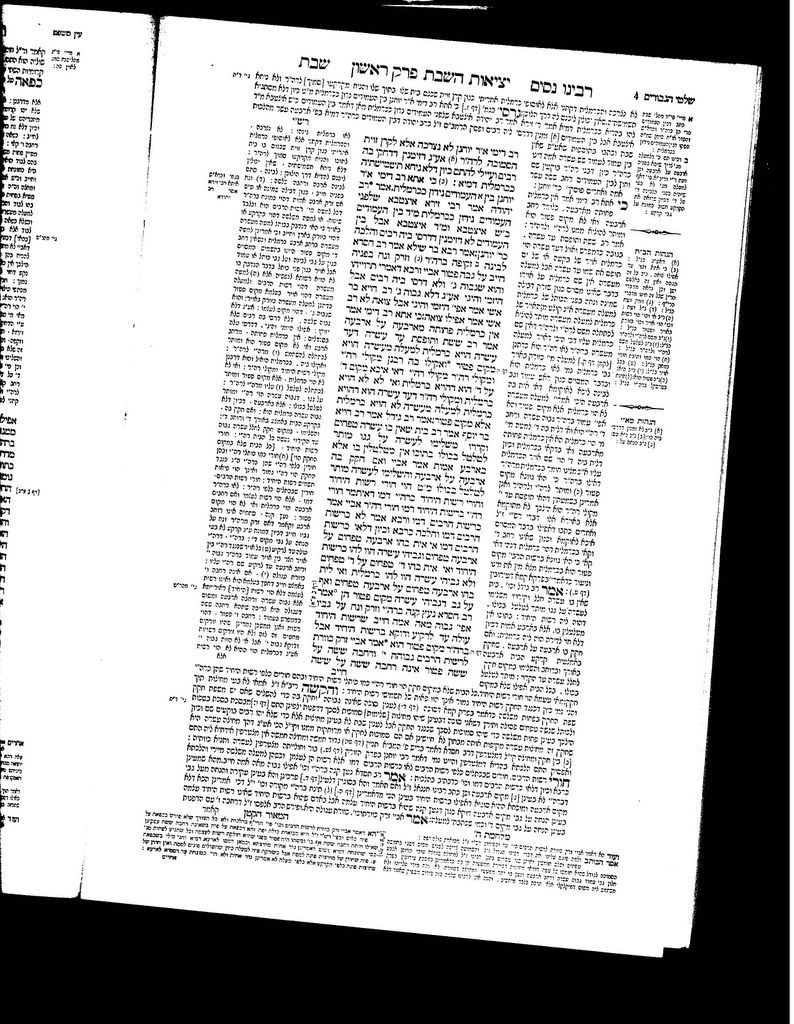
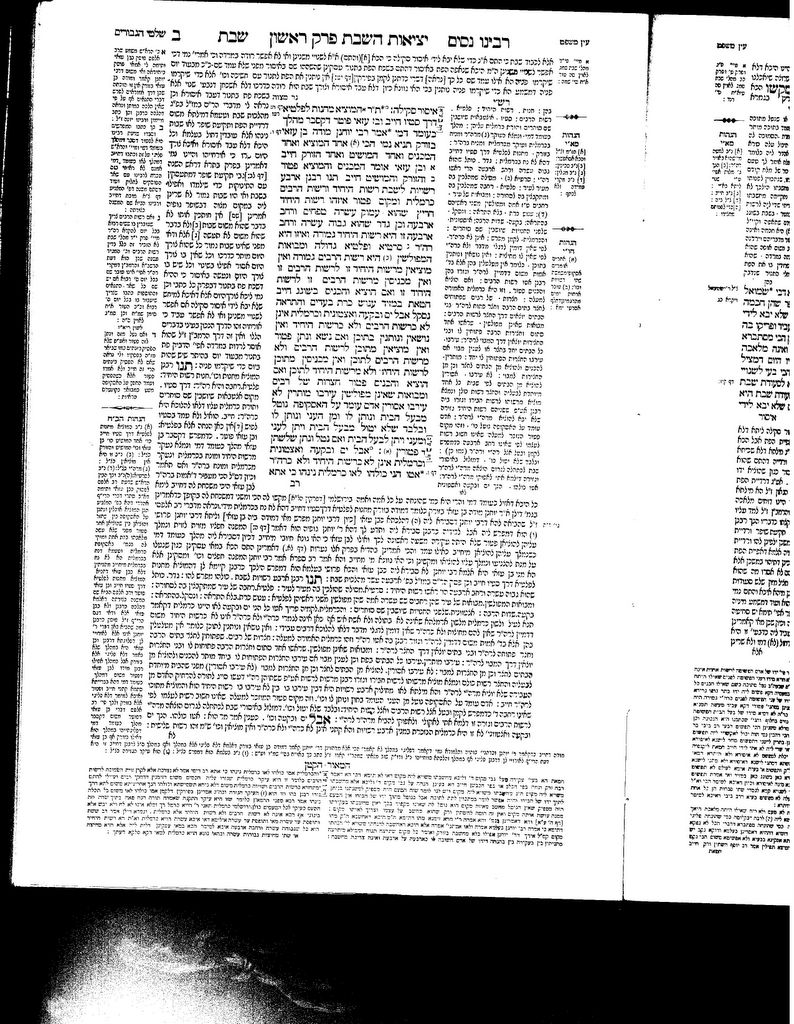
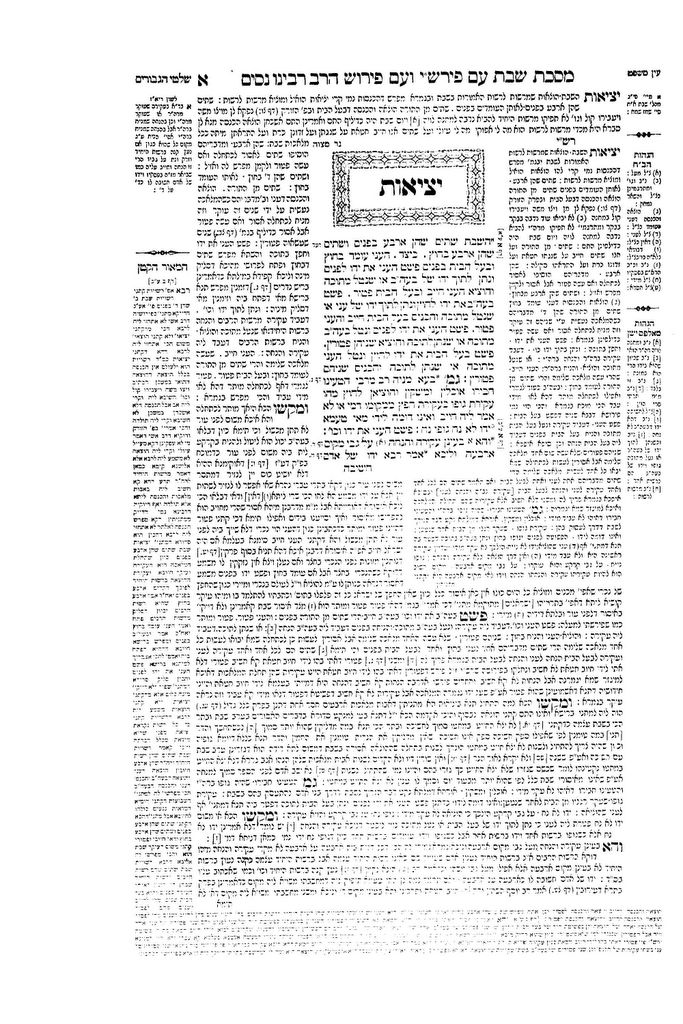
Rif Shabbat 4b


HIDE/SHOW IMAGE
4b

{Shabbat 10a continued}

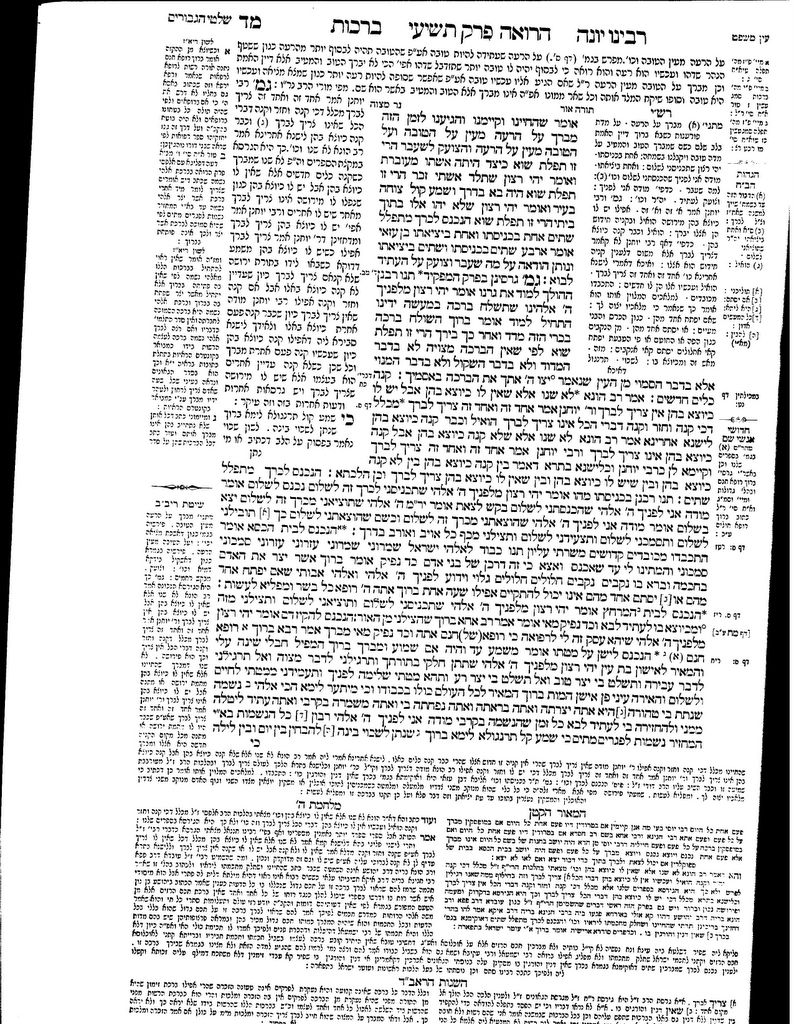
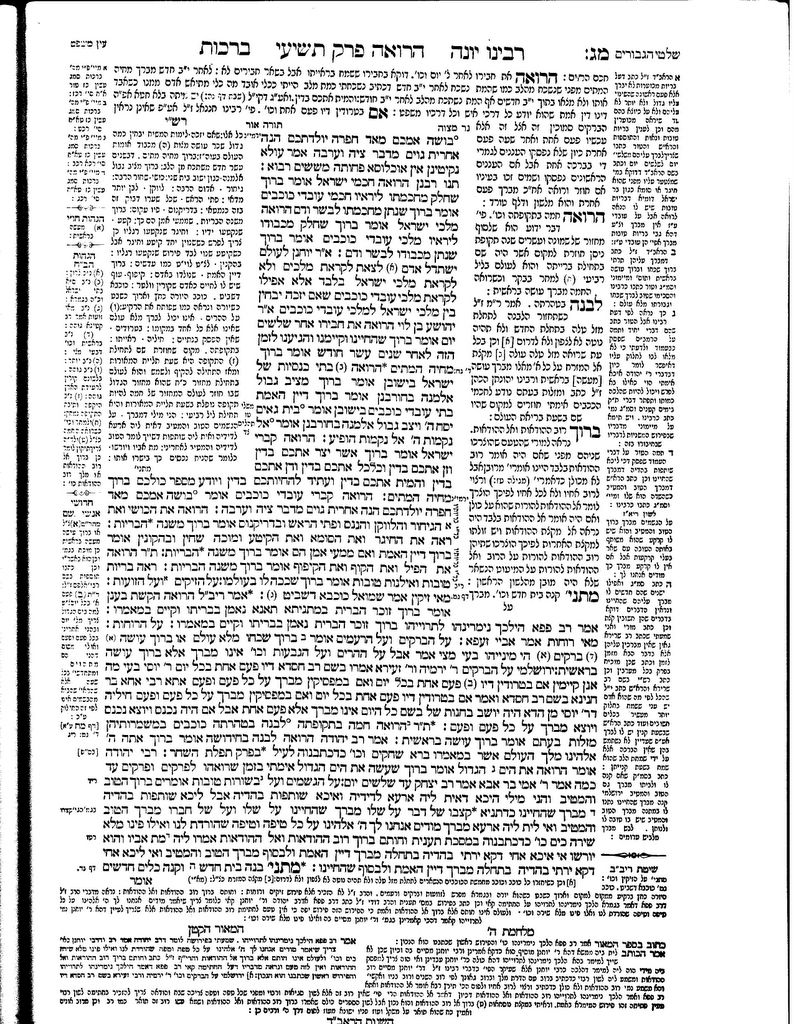
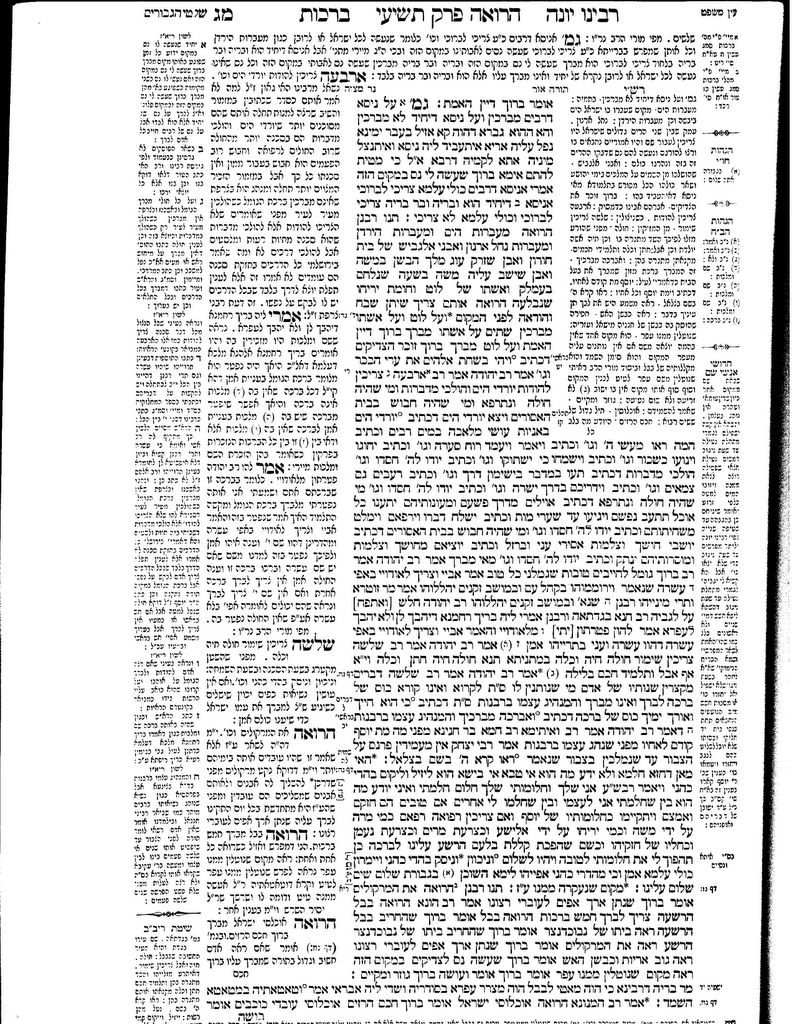
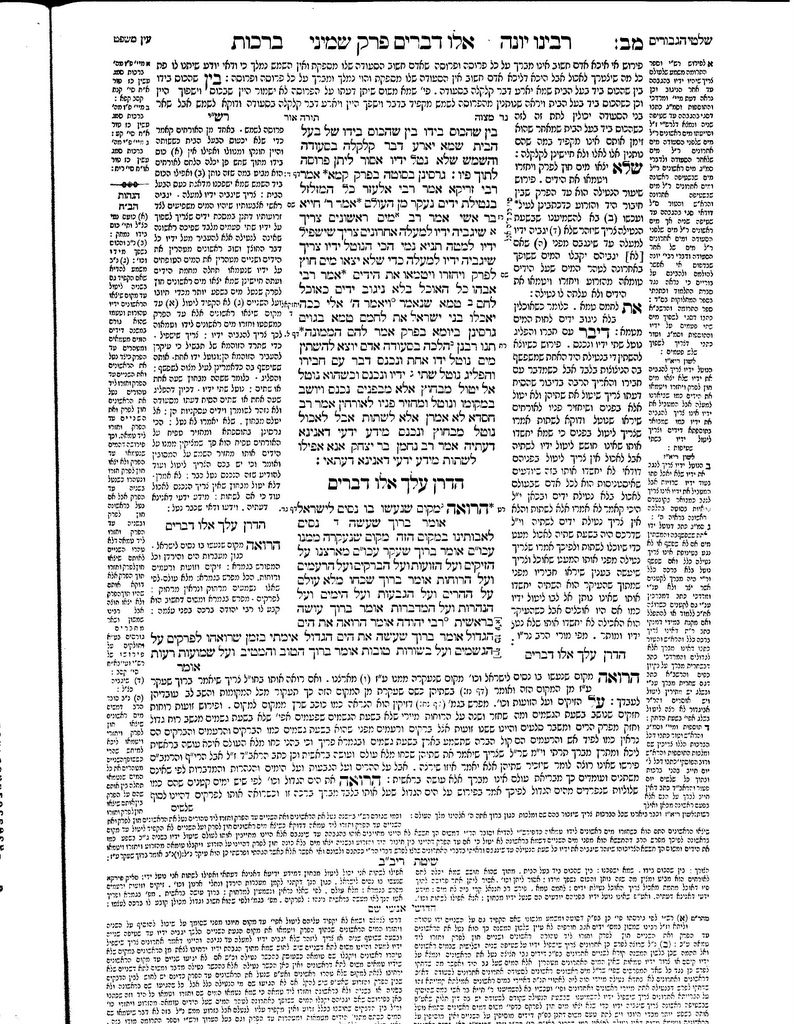
and he {Rabbi Yirmiyah} made haste {to finish learning so as to pray}.
Rabbi Zera called upon him {the verse in Mishlei 28:9:}

ט מֵסִיר אָזְנוֹ, מִשְּׁמֹעַ תּוֹרָה-- גַּם תְּפִלָּתוֹ, תּוֹעֵבָה. 9 He that turneth away his ear from hearing the law, even his prayer is an abomination.
{The Rif clarifies:} And specifically for someone for whom Torah is his profession, as we will want to say later on.


When is the beginning of a lawsuit? Rabbi Yona and Rabbi Yirmiyah {our gemara reverses the order} - one says: When the judges wrap themselves round {with a tallit}; and the other says: When the litigants commence [their pleas].

And they do not argue.
This when they are already engaged in judging {so they are already wrapped}; this, when they are not already engaged in judging.

Rabbi Ami and Rabbi Assi were sitting and learning between the pillars, and every hour {or, every now and then} they knocked at the side of the door and announced: If anyone has a lawsuit, let him enter and come.

Rav Chisda and Rabba bar Rav Huna were sitting all day engaged in judgements, and their hearts grew faint. {Rashi: since they were not able to learn Torah. Alternatively, they grew faint because they had not opportunity to eat all day.} Rav Chiyya bar Rav, of Difti, taught {tnei} (Shmot 18:13:)

יג וַיְהִי, מִמָּחֳרָת, וַיֵּשֶׁב מֹשֶׁה, לִשְׁפֹּט אֶת-הָעָם; וַיַּעֲמֹד הָעָם עַל-מֹשֶׁה, מִן-הַבֹּקֶר עַד-הָעָרֶב. 13 And it came to pass on the morrow, that Moses sat to judge the people; and the people stood about Moses from the morning unto the evening.
And does it enter your mind that Moshe sat and judged the entire day? And the {teaching/learning of} Torah, when was it done? Rather, to tell you that every judge who judges a true judgment {that is, a fair judgement}, even for one hour, the Scriptures considers him a partner in Creation. It is written here מִן-הַבֹּקֶר עַד-הָעָרֶב - from the morning unto the evening, and it is written there, by the Creation {Bereishit 1}, וַיְהִי-עֶרֶב וַיְהִי-בֹקֶר - "and there was evening and there was morning."

Until when must they {the judges} sit at judgment?
Rav Sheshet said: Until the time of the [main] meal [of the day].

And this is the sixth hour, which is the time of eating for a {Torah} scholar.

Rav Ada bar Ahava said: One may recite his prayers [the Eighteen Benedictions] at the baths.

And specifically in a new bathhouse, in which people have not bathed. But in an old bathhouse, in which people have already bathed, it is forbidden, for they learnt {in a brayta}:
If one enters the baths, in the place where people stand dressed, both reading [the shema'] and prayer [the Eighteen Benedictions] are permissible, and a greeting of 'Peace' may certainly be said, and one may don the phylacteries there, and it goes without saying that he need not remove them [if already wearing them];

in the place where people stand undressed, a greeting of 'Peace' is not permissible there and reading {Shema} and praying goes without saying {that one may not}; the phylacteries must be removed, and it goes without saying that they must not be donned.
{Shabbat 10b}
This supports Rav Hamnuna, for Rav Hamnuna cited Ulla: It is forbidden for a man to extend a greeting of 'Peace' to his neighbour in the baths, because it is said {in Shoftim 6:23}:

כג וַיֹּאמֶר לוֹ ה שָׁלוֹם לְךָ, אַל-תִּירָא: לֹא, תָּמוּת. 23 And the LORD said unto him: 'Peace be unto thee; fear not; thou shalt not die.'
{which is being interpreted as Shalom, peace, being Hashem's name}

Rabba bar Mechasia cited Rav Chama bar Guria who cited Rav: A man is permitted to say "By faith!" in a privy, even though it is written

ט וְיָדַעְתָּ, כִּי-ה אֱלֹקֶיךָ הוּא הָאֱלֹקִים: הָאֵל, הַנֶּאֱמָן--שֹׁמֵר הַבְּרִית וְהַחֶסֶד לְאֹהֲבָיו וּלְשֹׁמְרֵי מִצְו‍ֹתָו, לְאֶלֶף דּוֹר. 9 Know therefore that the LORD thy God, He is God; the faithful God, who keepeth covenant and mercy with them that love Him and keep His commandments to a thousand generations;
This instance of נֶאֱמָן {is an adjective rather than a proper noun} just as they say "faithful God" {in Aramaic translation of the verse} but as a Name itself He is not called נֶאֱמָן.

And one who gives a present to his friend need not inform him.

And these words are when it is going to eventually be revealed, for it is written {Shemot 34:29}:

כט וַיְהִי, בְּרֶדֶת מֹשֶׁה מֵהַר סִינַי, וּשְׁנֵי לֻחֹת הָעֵדֻת בְּיַד-מֹשֶׁה, בְּרִדְתּוֹ מִן-הָהָר; וּמֹשֶׁה לֹא-יָדַע, כִּי קָרַן עוֹר פָּנָיו--בְּדַבְּרוֹ אִתּוֹ. 29 And it came to pass, when Moses came down from mount Sinai with the two tables of the testimony in Moses' hand, when he came down from the mount, that Moses knew not that the skin of his face sent forth beams while He talked with him.
But for a present which will not eventually be revealed, he needs to inform him, for it is written {Shemot 31:13}:


יג וְאַתָּה דַּבֵּר אֶל-בְּנֵי יִשְׂרָאֵל, לֵאמֹר, אַךְ אֶת-שַׁבְּתֹתַי, תִּשְׁמֹרוּ: כִּי אוֹת הִוא בֵּינִי וּבֵינֵיכֶם, לְדֹרֹתֵיכֶם--לָדַעַת, כִּי אֲנִי ה מְקַדִּשְׁכֶם. 13 'Speak thou also unto the children of Israel, saying: Verily ye shall keep My sabbaths, for it is a sign between Me and you throughout your generations, that ye may know that I am the LORD who sanctify you.

Hashem said to Moshe: I have a precious gift in My treasure house, called the Sabbath, and desire to give it to Israel; go and inform them.

From here, Rabban Shimon ben Gamliel said: If one gives a loaf to a child, he must inform his mother.

What shall he do to him?

Rav Pappa said: He must rub him with the self-same kind {of food}.

And although Shabbat was a gift that was eventually going to be revealed, its reward was not something that was eventually going to be revealed.

And these words {that one must inform him} is with respect to a gift to a wealthy person, but a gift to a poor person, {Mishlei 21:14}:


יד מַתָּן בַּסֵּתֶר, יִכְפֶּה-אָף; וְשֹׁחַד בַּחֵק, חֵמָה עַזָּה. 14 A gift in secret pacifieth anger, and a present in the bosom strong wrath.
And Rabba bar Mechasia cited Rav Chama bar Guria who cited Rav: A man should never single out one son among his other sons, for on account of the two sela's weight of silk, which Yaakov gave Yoseph in excess of his other sons, his brothers became jealous of him and the matter resulted in our forefathers' descent into Egypt.

{Shabbat 11a}
And Rabba bar Mechasia cited Rav Chama bar Guria who cited Rav: Every city whose roofs are higher than the synagogue will ultimately be destroyed, as it is said {in Ezra 9:9}

ט כִּי-עֲבָדִים אֲנַחְנוּ--וּבְעַבְדֻתֵנוּ, לֹא עֲזָבָנוּ אֱלֹקֵינוּ; וַיַּט-עָלֵינוּ חֶסֶד לִפְנֵי מַלְכֵי פָרַס לָתֶת-לָנוּ מִחְיָה, לְרוֹמֵם אֶת-בֵּית אֱלֹקֵינוּ וּלְהַעֲמִיד אֶת-חָרְבֹתָיו, וְלָתֶת-לָנוּ גָדֵר, בִּיהוּדָה וּבִירוּשָׁלִָם.
9 For we are bondmen; yet our God hath not forsaken us in our bondage, but hath extended mercy unto us in the sight of the kings of Persia, to give us a reviving, to set up {lit. to raise up} the house of our God, and to repair the ruins thereof, and to give us a fence in Judah and in Jerusalem.
By way of explanation, just as one who raises up the house of our God causes the establishment {building up} of its ruins, so too one who does not raise up the house of our God causes that which is standing to become ruins.

And they only said this regarding his own house, but as for towers and turrets, we have no objection.

And Rabba bar Mechasia cited Rav Chama bar Guria who cited Rav: Fasting is as potent against a dream as fire against flax.
And Rav Chisda said: and {assuming one fasted} on that very day.
And Rav Yosef said: and even on Shabbat.

Rav Oshaya the son of Rav Idi visited the house of Rav Ashi. A third grown calf was prepared for him and he was invited, 'Master, partake somewhat.'
He said: I am engaged in a fast.
They said to him: Let master borrow it and repay. And do you not accept Rav Yehuda's ruling in Rav's name: One may borrow his fast and repay it?
He said to them: I am sitting {engaged} in a fast for a dream, and Rabba bar Mechasia cited Rav Chama bar Guria who cited Rav: Fasting is as potent against a dream as fire against flax. And Rav Chisda said: and {assuming one fasted} on that very day. And Rav Yosef said: and even on Shabbat.

And specifically a fast for a dream is permitted on Shabbat, but another type of fast, no, just as we learnt in perek Ain Omedin LeHitpallel {Brachot 5th perek, daf 31b}: Rabbi Eleazar cited Rabbi Yossi ben Zimra: Anyone who engages in a fast on Shabbat, they tear up for him the {evil} decree of 70 years. Rav Nachman {our gemara, bar Yitzchak, and attributes to him only the portion of making up the fast} said: And yet he is punished

Monday, May 09, 2005

Rif Shabbat 4a


HIDE/SHOW IMAGE
4a

{Shabbat 9b}
This "close to mincha" we conclude that it refers to close to greater {and earlier} mincha

{To cite an earlier definition, from Rif Brachot 18b on Brachot 26b:
What is Mincha Gedolah {greater afternoon}? From 6 and 1/2 hours and onward.
And what is Mincha Ketana {smaller afternoon}? From 9 and 1/2 hours and onward.
}

, and even in regard to our haircutting {which is easy and not as time-consuming}.
And why must he not sit down [for it] at the very outset?
As a decree lest the scissors be broken.

"NOR TO THE BATHS" - even merely for sweating.
And why not [do this] in the first place?
As a decree lest he faint.

"NOR A TANNERY" - even merely to inspect it.
And why not at the very outset?
Lest he see his wares being spoilt, which will trouble him.

"NOR TO EAT" - even for a small meal.
And why not at the very outset?
Lest he come to prolong it.

"NOR TO A LAWSUIT" - even for the end of the trial.
And why not [enter] at the very outset?
Lest he see an argument to overthrow the verdict

From what is considered the beginning of a haircut? {For the Mishna states that if one began he does not break off}
Rabbi Avin said: When the barber's sheet is placed on one's knees.

And what is considered the beginning of a bath?
Rabbi Avin said: When they remove the sheet from him. {gemara's girsa: משיערה; Rif: משיעביר}

And when is the beginning of tanning?
Rabbi Avin said {note: this attribution missing in our gemara}: When he ties [an apron] round his shoulders.

And when is the beginning of eating?
Rav said: When one washes his hands;
Rabbi Yochanan {our girsa: Chanina} said: When he loosens his girdle.

But they do not differ: the one refers to ourselves [Babylonians]: the other to them [residents of Israel].

Ze'eri {our gemara: Abaye - and perhaps it makes more sense for it to be Ze'eiri referring to "these Babylonian scholars"} said: These Babylonian scholars, according to the one who says that maariv is voluntary, once they have undone their girdle [to eat], we do not trouble them; but according to the one who says that it is obligatory, we trouble them.

But the mincha prayer, according to all it is obligatory, and we learn in the Mishna " YET IF THEY BEGAN, THEY NEED NOT BREAK OFF" and Rabbi Yochanan said: from when he loosens his girdle?!

{Shabbat 10a}
There {in the Mishna} drunkenness is not common; here, it is common.
Or else, mincha, since it has a set time, he will be afraid {of missing it} and will not come to neglect it; maariv, since the entire night is the time {acceptable} for prayer, he will not come to fear, and he will come to neglect it.

And now, the world treats the prayer of maariv as if it were obligatory, and even though he loosened his girdle, we trouble him.

Rabba {gemara: Rava} bar Rav Huna would put on stockings {/fine footwear} and pray. He said {by way of explanation, Amos 4:12:}

יב לָכֵן, כֹּה אֶעֱשֶׂה-לְּךָ יִשְׂרָאֵל: עֵקֶב כִּי-זֹאת אֶעֱשֶׂה-לָּךְ, הִכּוֹן לִקְרַאת-אֱלֹקֶיךָ יִשְׂרָאֵל. 12 Therefore thus will I do unto thee, O Israel; because I will do this unto thee, prepare to meet thy God, O Israel.
Rava, when there was pestilence {Bach removes this, and the girsa in our gemara does not have it} removed his {costly} cloak {as a mark of humility}, clasped his hands and prayed, saying '[I pray] like a slave before his master.' When there was no perstilence, he would mark himself {as special, by wearing nice clothing}. {Again, the Bach crosses this out, and the girsa in our gemara does not have it.}
Rav Ashi said: I saw Rav Kahana, when there was pestilence {our gemara: suffering} in the world, he would dress and cover himself {Bach emends to "remove his cloak"}, clasp his hands, and pray, saying '[I pray] like a slave before his master.' When there was no pestilence {our gemara: when there was peace} he would make himself special and pray {our gemara: dress, cover and wrap himself} saying, {Amos 4:12:}
יב לָכֵן, כֹּה אֶעֱשֶׂה-לְּךָ יִשְׂרָאֵל: עֵקֶב כִּי-זֹאת אֶעֱשֶׂה-לָּךְ, הִכּוֹן לִקְרַאת-אֱלֹקֶיךָ יִשְׂרָאֵל. 12 Therefore thus will I do unto thee, O Israel; because I will do this unto thee, prepare to meet thy God, O Israel.
Rava found Rav Hamnuna prolonging his prayer. He {Rava} said: They set aside eternal life and occupy themselves with temporal life {by praying, and thus asking for needs of this world, instead of learning Torah}.
And he {Rav Hamnuna} held that the time for prayer and the time for [study of the] Torah are distinct from each other.
{That is, there is no obligation to learn when one is involved in prayer, so by prolonging his prayer, he is not forsaking Torah during that time.}

Rabbi Yirmiyah was sitting before Rabbi Zera and was learning. The time for prayer arrived

Rif Shabbat 3b


HIDE/SHOW IMAGE
3b

{Shabbat 9a continued}
Rav Yehuda cited Rav: he reference here is to the threshold of an alley, half of which [threshold] is covered and half uncovered, the covering being toward the inner side: [hence] if the door is open, it is as within; if the door is shut, it is as without.

{Shabbat 9b}

MISHNAH.
ONE MUST NOT SIT DOWN BEFORE A BARBER NEAR mincha UNTIL HE HAS PRAYED:
YET IF THEY BEGAN, THEY NEED NOT BREAK OFF.NOR MAY HE ENTER THE BATHS OR A TANNERY, NOR TO EAT NOR FOR A LAWSUIT,
ONE MUST BREAK OFF FOR THE READING OF THE SHEMA', BUT NOT FOR PRAYER.

Rif Shabbat 3a


HIDE/SHOW IMAGE - there is a diagram
3a

{Shabbat 8a continued}
By way of explanation: any place 10 {handbreadths} high and 4 X 4 {handbreadths - the Bach emends and fixes the gender of the numbers} separates off a domain for itself, and is a private domain.

And therefore, someone who throws a {round} bin into the public domain is exempt {from liability}, for since it is 10 handbreadths high and 4 X 4 {handbreadths} wide, it separates off a domain for itself, and he is like one who has thrown from one private domain to another private domain, which is exempt.

And they only said that you need a width of 6 {handbreadths} because it {the bin} is circular, because it is impossible to inscribe {a square} 4 X 4 {handbreadths - gender of number is wrong} unless there is in the width {of the circle - that is the diameter} 6 X 6, as we say: for each cubit in the side of a square, there are 1 and 2/5 cubits in its diagonal. And it is a known fact that the width of a circle is equal to the length of the length of the diagonal of the square
inscribed in the circle, and this is its diagram, so that it is made clear by seeing it.
{It is in fact obvious, especially when you see the diagram. Click the link above to see the scan of the page, which has the diagram.}

And therefore we need to add in the width of the circle, which is the diagonal of the square, 2/5 of 4 handbreadths, for a total of 8/5th, that is 2/5 for each and every handbreadth, such that the length of the side of the square inscribed in it is 4 handbreadths. And we have further added an additional 2/5ths for the thickness of the walls of the bin, 1/5th here and 1/5th there, for a total of 10/5ths, which are = 2 handbreadths, such that we have 6 handbreadths, no less and no more.

{Using contemporary mathematics, rather than the fairly good estimate of 1:1.4 ratio for length of side:diagonal, we can get a slightly more accurate calculation. That is, the length of the diagonal of the inscribed square = the diameter of the circle, as we see in the Rif's diagram. We know the length of the square must be 4. What will be the length of the diagonal of the square, and thus the diameter of the circle?
We can use the Pythagorean theorem. For a right triangle with sides a and b, and a hypotenuse c:

a2 + b2 = c2

Now, since it is a square, a and b are the same. Therefore:

a2 + a2 = c2

or

2a2 = c2

Now, a = 4, so a2 = 16, and 2a2 = 32;

So, c2 = 32; Taking the square root of each side, c = square root (32) ~= 5.65685425. This means that the diameter of the circle, c, needs to be 5.65685425, which is less than 6. However, perhaps the gemara was dealing in whole units, and thus used 6 handbreadths, since 5 would not be sufficient. Or, like the Rif, we can divide the remaining width into the two walls of the bin. 6 - 5.65685425 = 0.34314575, which is even slightly less than the 2/5 = 0.4 that the Rif had in excess.

Update: To relate this to the Rif's calculation, consider:

2a2 = c2

Therefore,

c = square root(2a2) = square root(2) X square root(a2) = a X square root(2)

Thus, to find the diagonal of a square, rather than multiplying a side a by 1.4, which is the good estimate of the Rif, one should multiply it by the square root of 2, which is approximately 1.414.
}

Rava said: Even if its width was not 6 X 6 he is exempt.
What is the reason?
It is impossible that the piece of cane not project above ten, so that it is a mekom petur.
If he overturns it {where it is less than 6 wide}, mouth downwards, [and throws it], then if it is a shade more than seven [in height] he is liable; if seven and a half, he is exempt.

{Because lavud makes it so that items within 3 handbreadths of the ground are considered resting on the ground. Therefore, when it is within 3, then if it is 7 handbreadths high, it is entirely within 10 handbreadths of the ground, and he is liable. The same for 7 and a tiny bit, since he needs to be within a tiny bit of the 3 for lavud to operate. However, if it is 7 1/2 handbreadths high, then when it first enters the 3 handbreadth space, part of it projects over 10 handbreadths, so that it is in a mekom petur.}

Rav Ashi said: Even if its height is 7 1/2 {handbreadths} he is also liable.
What is the reason?
The walls are made for their contents {to hold the contents, and not to create an imaginary wall downward}, and we cannot use it to make it higher than 10, and therefore he is liable.

Ulla said: If there is a column nine [handbreadths high] in the street, and the public rest and rearrange their burdens thereon, and one throws [an object] and it alights upon it, he is liable.
What is the reason?
Anything less than 3 {handbreads} the public tramples upon; from 3 until 9, the public does not trample upon, and they do not rearrange their burdens thereon; 9 they certainly rearrange their burdens thereon {Rashi: and since it is for the purpose of the public it is considered the public domain}.

Abaye said to Rav Yosef: What of a pit {which is 9 deep}?
He said to him: And so too a pit.
Rava said: A pit, no.
What is the reason?
He holds: Walking albeit with difficulty is considered walking; service {use by the public} with difficulty is not considered use.

{Shabbat 8b}
Rav Yehuda said: In the case of a zirza dekanei {a bundle of canes}: if one raises this end and lowers the other, then raises that end and lowers the other {thus transporting it head over heels}, he is not liable until he uproots it.
By way of explanation, a zirza dekanei is a bundle of canes, which is lying on the ground, and he lifts one end and the other end is resting on the ground. And he raises it until upright {perfectly vertical} and then casts it before him. And he returns and lifts up the other end which was resting on the ground, and raises it upright and then casts it before him. And he returns and lifts it up, etc., even the entire day, he is not liable, for he never uprooted it from the ground.

A man standing on a threshold may take [an object] from or give [it] to the master of the house, and may take an object] from or give [it] to the poor man.

This "threshold," what is it?
And we conclude that the "threshold" is a mekom petur, such that it does not have an area 4 X 4 {handbreadths} and like this {statement} that when Rav Dimi came, he cited Rabbi Yochanan that does not have 4 X 4 {handbreadths} it is permitted for the people in the public domain and the people in the private domain to rearrange their burdens thereon, so long as they do not switch.
{that is, someone from the public domain puts his burden in this place, and someone from the private domain takes it, or the opposite case}

{Shabbat 9a}
Others state: A threshold serves as two domains: if the door is open, it is as within; if the door is shut, it is as without.

Friday, May 06, 2005

Rif Shabbat 2b


HIDE/SHOW IMAGE
2b

{Shabbat 7a continued}
he cited Rabbi Yochanan:
This is necessary only in respect of a corner near a street {Soncino: at which stood a house the front of which the owner had thrown open to the public} though the masses sometimes press and overflow therein, yet since it is inconvenient for [general] use, it ranks as a karmelith.

When Rav Dimi came, he cited Rabbi Yochanan: [The place] between the pillars {erected in the market upon which traders hung their wares} is treated as a karmelith.

Rav Yehuda cited Rabbi Zera {our girsa: Rabbi Zera cited Rav Yehuda}: The balcony in front of the pillars is treated as a karmelith.

Now, he who stated thus of [the ground] between the pillars, — how much more so the balcony! But he who mentions the balcony-but between the pillars, no, for there are times that the public trods there.

And the halacha is like Rabbi Yochanan {that between the pillars as well as the balcony is considered a karmelith}.

Rava bar Shela cited Rav Chisda: If a brick is standing upright in the street, and one throws [an article] {at least four cubits in the street} and it adheres to its side, he is liable; on top, he is not liable {since it forms a separate domain}.

Abaye and Rava both state: {on top he is not liable} Providing that it is three handbreadths high, and {our girsa: so that ד/ו} the public do not step on it, but thorns and shrubs, even though they are not three handbreadths high {, no - that is, he would be liable, since it is part of the street}.
Rav Chiyya bar Ashi said: Even thorns and shrubs, but dung, no.
Rav Ashi said: Even dung.

When Rav Dimi came, he said {our gemara: in the name of Rabbi Yochanan}: There is no karmelith less than four by four {handbreadths}.

Rav Shesheth said: And it extends up to ten {handbreadths}.

That until ten, it is a karmelith. Higher than ten, it is a mekom petur {a place of non-liability}.

{Shabbat 7b}
And the Sages treated it with the leniencies of the private domain and the leniencies of the public domain.
With the leniencies of the private domain - that if there is a place 4 X 4 {handbreadths} it is a karmelith, and if not, it is not a karmelith.
With the leniencies of the public domain - that until ten {handbreadths} it is a karmelith, and higher than ten, it is not a karmelith but rather a mekom petur.

Rav Gidel cited Rav Chiyya bar Yosef, who cited Rav: A house which does not have inside of it ten handbreadths, but its ceiling completes it to a height of ten - upon its roof it is permitted to carry throughout, but inside, one may only carry within four cubits {that is, it has the status of karmelith}.
Abaye said: And if he carved out {in the floor} an area 4 X 4 {handbreadths}, thus completing its height of ten, it is permitted to carry inside throughout.
What is the reason?
It has the status of the cavities of the private domain, and the cavities of the private domain is like the private domain.
For it was stated {by Amoraim}: and the cavities of the private domain is like the private domain; the cavities of the public domain - Abaye said: is like the public domain, and Rava said: it is not like the public domain.

And the halacha is like Rava, and since it {the cavities of the public domain} is not like the public domain, if it has 4 X 4 handbreadths and its height is ten {handbreadths}, it is like the private domain; and if it has 4 X 4 handbreadths but its height is not ten, it is like a karmelith; and if it does not have 4 X 4 handbreadths, even if its height is ten, it is a mekom petur.

Rav Chisda said: If one fixes a rod in private ground and throws [an article from the street] and it alights on the top, even if it is a hundred cubits high, he is liable, because private ground extends up to heaven.

And specifically {if he fixes it} in the private domain, but in the public domain, it is a mekom petur.

{Shabbat 8a}
Abaye said: If one throws a {round, large} bin into the public domain, which {the bin} is ten {handbreadths} high and 6 X 6 {handbreadths} wide, he is not liable; if it is not 6 X 6 wide, he is liable.

Rif Shabbat 2a


HIDE/SHOW IMAGE
2a

{Shabbat 5b}
The Sages learnt {in a brayta}: One who carries from a shop {chanut, which is a private domain} to an open space {platya, which is a public domain} via a colonnade {which is a karmelit}, he is liable. And Ben Azzai exempts {hom from liability}, for he maintains that walking is like standing in place.

{And, as Rashi explains, when he walks through the colonnade, which has the status of karmelit, and therefore he carried first from the shop, the private domain, into the karmelit, and this is a stop, and then carries from the karmelit into the open space, and for both of these things, if one transfers between a karmelit and either a public or private domain, he is exempt, as we will see shortly.}

{Shabbat 6a}
Rabbi Yochanan said: Ben Azzai admits {to the Sages that he is liable} in the case of throwing {as opposed to walking}.
A brayta also says so: If one carries [an object] from a shop to an open place through a colonnade, he is liable, whether he carries [it] out or carries [it] in; or whether he reaches it across or throws it. Ben Azzai said: If he carries it out or in, he is exempt; if he reaches it across or throws it, he is liable.

The Sages learnt {in a brayta}:

There are four domains in respect to the Sabbath; private ground, public ground, karmelith, and a place of non-liability.

And what is private ground? A trench ten [handbreadths] deep and four wide, and likewise a wall ten [handbreadths] high and four broad, — that is absolute private ground.

And what is public ground? A highroad {Jastrow: a camp}, a great public square, and open alleys {where both ends open into streets}, — that is absolute public ground.

One may not carry out from this private to this public ground, nor carry in from this public to this private ground; and if one does carry out or in, unwitting, he is liable to a sin-offering; if deliberately, he is punished by kareth; with witnesses and warning: stoning.

But the sea, a plain, a colonnade, or a karmelith, ranks neither as public nor as private ground.

One must not carry [objects] about within it and if he does, he is not liable; and one must not carry out [an object] thence into public ground or from the public ground into it, nor carry [an object] from it into private ground or from the private ground into it; yet if he does carry out or in, he is not liable.

As to courtyards with many owners and blind alleys {in which only one side opens into a street}, if an eruv is made, they are permitted; if an eruv is not made, they are forbidden.

A man standing on a threshold {which has less than 4 X 4 handbreadths} may take [an object] from the master of the house, or give [it] to him, and may take [an object] from the poor man or give [it] to him; providing however that he does not take from the master of the house and give to the poor man or from the poor man and give it to the master of the house, and if he does take and give, the three are exempt.
{Now, the brayta had said:} "But the sea, a plain, a colonnade, or a karmelith, ranks neither as public nor as private ground":

{Shabbat 7a}
Are then all these [sea, plain and colonnade] too not karmelith?
When R. Dimi came {from Israel to Bavel}

Wednesday, May 04, 2005

Rif Shabbat 1b


HIDE/SHOW IMAGE
1b

{Shabbat 5a continued}
And so too when Rabin came {from Israel to Bavel} he cited Rabbi Yochanan: a man's hand is considered for his as 4 X 4 {handbreadths}.

{Shabbat 3b}
They learnt {in a brayta}: If one's hand is filled with fruit and he stretches it outside, it is forbidden to bring it back; and another brayta: it is permitted to bring it back.
Both this and this {brayta} are dealing with his initial action being non-deliberate, and it is no contradiction. Here {where he may bring it back} is to the same courtyard {in which it was initially}, and here is to another courtyard.

{Shabbat 4a}
And it is as Rava asked of Rav Nachman: If a person holds a handful of produce in his hand and he extends it without, may he withdraw it into the same courtyard?
He replied, It is permitted.
And what about another courtyard?
Said he to him, It is forbidden.
And what is the difference?
He said to him: When you measure out a measure of salt for it! There his intention is not carried out; here his intention is carried out.

Rav Bibi bar Abaye said: If one places a loaf of bread in an oven, do they permit him to remove it before he incurs the liability of a stoning or not?
{our gemara, initially: "sin-offering," rather than "stoning" - the Rif is following Rav Ashi's emendation, and Rav Acha the son of Rava's even initial version of the statement}

{Says the Rif}: In this matter, the {post-Talmudic} Sages asked: Let us see - removing the bread is a chochma {wisdom, henceforth "art"} and not a melacha {act of "work"} as we learn in perek kol kitvei kodesh {Shabbat perek 16, daf 117b}: They learnt in the School of Shmuel {our gemara: school of Rabbi Yishmael}: {one of the occurences in Vayikra 23 - our gemara cites a different pasuk from Shemot 20} כָּל-מְלֶאכֶת עֲבֹדָה, לֹא תַעֲשׂוּ - "ye shall do no manner of servile work" - to exclude the removal of bread {from the oven} and the blowing of the shofar which are art, rather than work.

But then why here do they only allow him here so that he does not come to a liability of stoning, implying that if this were not so, it would be forbidden? But why? He would not have been doing an act of "work?" And they give many answers which are unsatisfactory to us, and because of this, we have not written them down {here}. But for us, this is what seems like the logical answer to this question: Although removal of the bread in the oven is an art and not work, the Sages only permitted it when he forgot and left bread in the over, and the day became sanctified upon him {that it, night fell, and it became Shabbat}, since he can salvage from it provision for three meals for Shabbat, because of the honor of Shabbat, and even so, he needs to do it {remove the bread} with a change, as we learn later on {Shabbat 117b}: "and he must not remove it with a mardeh {a baker's shovel, usually used to remove bread}, but with a knife." But removal not for the meals of Shabbat, the Sages did not permit, even via a change. And the removal {of bread} here {in Rav Bibi bar Abaye's statement} is not for the purpose of meals, for it is not {yet} fit for consumption, and therefore the Sages did not permit it except so that he would not come to violate a prohibition carrying a penalty of stoning.

Rif Shabbat 1a


HIDE/SHOW IMAGE
1a

{Shabbat 2a}
MISHNAH.
THE CARRYINGS OUT OF THE SABBATH ARE TWO WHICH ARE FOUR WITHIN, AND TWO WHICH ARE FOUR WITHOUT.
HOW SO?

THE POOR MAN STANDS WITHOUT AND THE MASTER OF THE HOUSE WITHIN:

[i] IF THE POOR MAN STRETCHES HIS HAND WITHIN AND PLACES [AN ARTICLE] INTO THE HAND OF THE MASTER OF THE HOUSE, OR
[ii] IF HE TAKES [AN ARTICLE] FROM IT AND CARRIES IT OUT,
THE POOR MAN IS LIABLE, AND THE MASTER OF THE HOUSE IS EXEMPT.

[AGAIN]
[i] IF THE MASTER OF THE HOUSE STRETCHES HIS HAND WITHOUT AND PLACES [AN OBJECT] IN THE POOR MAN'S HAND, OR
[ii] TAKES [AN OBJECT] THEREFROM AND CARRIES IT IN,
THE MASTER IS LIABLE, WHILE THE POOR MAN IS EXEMPT.

[iii] IF THE POOR MAN STRETCHES HIS HAND WITHIN AND THE MASTER TAKES [AN OBJECT] FROM IT, OR PLACES [AN OBJECT] THEREIN AND HE CARRIES IT OUT, BOTH ARE EXEMPT;

[iv] IF THE MASTER STRETCHES HIS HAND WITHOUT AND THE POOR MAN TAKES [AN OBJECT] FROM IT, OR PLACES [AN ARTICLE] THEREIN AND HE CARRIES IT INSIDE, BOTH ARE EXEMPT

{Shabbat 3a}
Gemara:
Rav asked Rabbi: If one's neighbour loads him with food and drink, and he carries them without, what is the law? Is the removing {uprooting} of one's body like the removing of an article from its place, and so he is liable; or perhaps it is not so?
{that is, we see in the Mishna that two things are required for one to be liable - uprooting and placing down =depositing, and perhaps moving one's body is considered an act of uprooting, where clearly simply moving one's hand is not.}

He said to him: He is liable, and it is not similar to {merely moving} his hand.
What is the reason?
His hand does not rest, whereas his body rests {and thus moving it is an act of uprooting}.

{Shabbat 4a}
{The Mishna had said:} "IF THE POOR MAN STRETCHES HIS HAND etc.": {
But we need uprooting and depositing into a place 4 {square handbreadths}, which is not present in this case? {since he is placing it into the rich man's hand, which is by definition about 1 handbreadth}.

{Shabbat 5a}
Rava said: a man's hand is considered as if it is {an area} of 4 x 4 {handbreadths}.

Tuesday, May 03, 2005

Rif Brachot 45a


HIDE/SHOW IMAGE
45a

{Brachot 61b continued}
where he is in sight of it.

Rabbi Yehuda says: When the Temple is in existence it is forbidden, when the Temple is not in existence it is permitted.

Rabbi Akiva prohibits in all instances.

Rabbi Akiva, this was {the same position as} the first Tanna?

There is a distinction between them: outside Israel. That the first Tanna maintains that outside Israel it is permitted, while Rabbi Akiva maintains that outside Israel it is forbidden. Rabba had bricks placed for him east and west, such that he would sit and answer the call of nature north and south. Abaye went and changed them round to north and south. Rabbah went in and readjusted them. He said, Who is this that is annoying me? The halacha is like Rabbi Akiva.

{Brachot 62a}
They learnt {in a brayta}: Rabbi Akiva said: Once I went in after Rabbi Yehoshua to a privy, and I learnt from him three things. I learnt that one does not sit east and west but north and south; I learnt that one evacuates not standing but sitting; and I learnt that it is proper to wipe with the left hand and not with the right. Said Ben Azzai to him: Did you dare to take such liberties with your master? He replied: It was a matter of Torah, and I required to learn.

Who is a modest man? One who eases himself by night in the place where he eased himself by day.

Ulla said: Behind a fence one may ease himself immediately; in an open field, so long as he can break wind without anyone hearing it.

Rav Ashi said: As long as the exposed part of his body cannot be seen.

{Brachot 62b}
They learnt {in a brayta}: Rabban Shimon ben Gamliel says: To keep back the fecal discharge causes dropsy; to keep back the urinary discharge causes jaundice.

{The Mishna had stated:} "A MAN SHOULD NOT ENTER THE TEMPLE MOUNT":

Rav Nachman cited Rabba bar Avua: If one enters a synagogue not intending to use it as a short cut {kapandaria}, he may use it as a short cut {kapandaria}.

What is a kapandaria?
It is as if a man said, instead of going round the blocks [makkifna adari], I will go in here.
{Thus, an Aramaic etymology. Rabba, earlier, said kimashmao. Meaning, as Soncino notes, that the Latin word compendiaria is sufficient.}

Rav Chelbo cited Rav Huna: If one entered a synagogue to pray, it is a mitzvah to use it as a short cut {the Rif has the girsa mitzvah, as opposed to our girsa, muttar, it is permitted - this is when going in to pray from one entrance, one should use the opposite exit}, as it says (in Yechezkel 46:9)

ט וּבְבוֹא עַם-הָאָרֶץ לִפְנֵי ה, בַּמּוֹעֲדִים, הַבָּא דֶּרֶךְ-שַׁעַר צָפוֹן לְהִשְׁתַּחֲו‍ֹת יֵצֵא דֶּרֶךְ-שַׁעַר נֶגֶב, וְהַבָּא דֶּרֶךְ-שַׁעַר נֶגֶב יֵצֵא דֶּרֶךְ-שַׁעַר צָפוֹנָה: לֹא יָשׁוּב, דֶּרֶךְ הַשַּׁעַר אֲשֶׁר-בָּא בוֹ--כִּי נִכְחוֹ, יצאו (יֵצֵא. 9 But when the people of the land shall come before the LORD in the appointed seasons, he that entereth by the way of the north gate to worship shall go forth by the way of the south gate; and he that entereth by the way of the south gate shall go forth by the way of the north gate; he shall not return by the way of the gate whereby he came in, but shall go forth straight before him.
Rabbi Yehoshua ben Levi said:Anyone who spits when on the Temple Mount in these days {when there is no Temple on the Mount}, it is as if he spit in His eye {of Hashem}, as it states: {Melachim I, 9:3}
ג וַיֹּאמֶר ה אֵלָיו, שָׁמַעְתִּי אֶת-תְּפִלָּתְךָ וְאֶת-תְּחִנָּתְךָ אֲשֶׁר הִתְחַנַּנְתָּה לְפָנַי--הִקְדַּשְׁתִּי אֶת-הַבַּיִת הַזֶּה אֲשֶׁר בָּנִתָה, לָשׂוּם-שְׁמִי שָׁם עַד-עוֹלָם; וְהָיוּ עֵינַי וְלִבִּי שָׁם, כָּל-הַיָּמִים. 3 And the LORD said unto him: 'I have heard thy prayer and thy supplication, that thou hast made before Me: I have hallowed this house, which thou hast built, to put My name there for ever; and Mine eyes and My heart shall be there perpetually.
Rabba said: And spitting inside the shul is permitted.
What is the reason?
We learn from wearing a shoe. Just as wearing shoes is permitted, so too is spitting permitted.

{Brachot 63a}
Rava said: Like his house.
Just as in his house, taking a shortcut, people object, but wearing shoes and spitting they do not object, so too in a shul, taking a shortcut {when not going in to pray in the meantime} is forbidden, and wearing shoes and spitting is permitted.

{Brachot 64a}
Rabbi Chiyya bar Ashi cited Rav: One who leaves the shul and enters the house of study is deemed worthy to welcome the Divine Presence, as it says {in Tehillim 84:8}:

ח יֵלְכוּ, מֵחַיִל אֶל-חָיִל; יֵרָאֶה אֶל-אֱלֹקִים בְּצִיּוֹן. 8 They go from strength to strength, every one of them appeareth before God in Zion.

HADRAN ALACH HAROEH USLIKA LA MASECHET BRACHOT

END NINTH PEREK
END MASECHET BRACHOT

Monday, May 02, 2005

Rif Brachot 44b


HIDE/SHOW IMAGE
44b

{Brachot 60b continued}
When he dresses he should say: Blessed is He who clothes the naked.

When he wraps himself with the {fringed} garment he should say: Blessed is He who has sanctified us with His commandments and commanded us to enwrap ourselves in the fringed garment.

When he places his hands on his eyes he should say: Blessed is He who opens the eyes of the blind.

When he stretches himself and sits up he should say: Blessed is He who loosens the bound.

When he steps on to the ground he should say: Blessed is He who spread the earth on the waters.

When he draws himself up he should say: Blessed is He who raises the bowed.

When he washes his hands he should say: Blessed is He who has sanctified us with His commandments and commanded us concerning the washing of hands.

When he washes his face he should say {different girsa}: Blessed is He who has removed the bands of sleep from mine eyes and slumber from mine eyes. May it be Your will O Lord, to grant me my portion in your Torah and force my inclination to subservience to You. And give me over to grace, lovingkindness, and mercy in Your eyes and in the eyes of all who see me. Blessed art Thou, O Lord, who bestowest lovingkindness.

When he fastens his girdle, he should say: Blessed is He who girds Israel with might.

When he ties his shoes he should say: Blessed is He who has supplied for me {sheAsita li} all my needs.

When he commences to walk he should say: Blessed is He who makes firm the steps of man.

We learn in perek haTecheilet {Menachot, 4th perek, daf 43b}: Rabbi Meir says: one is required to bless 100 blessings a day. For it is stated {Devarim 10:12}

יב וְעַתָּה, יִשְׂרָאֵל--מָה ה אֱלֹקֶיךָ, שֹׁאֵל מֵעִמָּךְ: כִּי אִם-לְיִרְאָה אֶת-ה אֱלֹקֶיךָ לָלֶכֶת בְּכָל-דְּרָכָיו, וּלְאַהֲבָה אֹתוֹ, וְלַעֲבֹד אֶת-ה אֱלֹקֶיךָ, בְּכָל-לְבָבְךָ וּבְכָל-נַפְשֶׁךָ. 12 And now, Israel, what doth the LORD thy God require of thee, but to fear the LORD thy God, to walk in all His ways, and to love Him, and to serve the LORD thy God with all thy heart and with all thy soul;
Read not מָה (what) but rather מאה a(100).

Rabbi Chiyya bar Avya said: On Shabbat and Yom Tov, which do not have many blessings {since Shemoneh Esrei is shorter}, he should complete it {the sum of 100 blessings} with aparmekei and megadei{Rashi: types of fruit}.

They learnt {in a brayta}: Rabbi Yehuda would say: One is required to bless three blessings every day - that You have not made me a gentile, or an ignoramus, or a woman.

Rav Acha bar Yaakov heard his son bless "Who has not made me an ignoramus." He said to him: even so far, also?! {do you bless, to encompass even this. Or perhaps - do you consider yourself so great that you think you are not an ignoramus}
But how shall I bless?
"That you have not made me a slave."
But a slave is the same as a woman {either in terms of the commandments they are obligated in, or perhaps in stature}
A slave is more degraded.

{Brachot 54a}
MISHNA:
IT IS INCUMBENT ON A MAN TO BLESS [GOD] FOR THE EVIL IN THE SAME WAY AS FOR THE GOOD, AS IT SAYS, AND THOU SHALT LOVE THE LORD THY GOD WITH ALL THY HEART ETC.
'WITH ALL THY HEART, MEANS WITH THY TWO IMPULSES, THE EVIL IMPULSE AS WELL AS THE GOOD IMPULSE;
'WITH ALL THY SOUL' MEANS, EVEN THOUGH HE TAKES THY SOUL [LIFE];
'WITH ALL THY MIGHT' MEANS, WITH ALL THY MONEY.

ANOTHER EXPLANATION OF 'WITH ALL THY MIGHT [ME'ODEKA]' IS, WHATEVER MEASURE HE MEASURES {moded} OUT TO THEE, IN ALL THANK HIM {modeh}

{Brachot 60b}
Gemara:
One is required to bless on that bad 'Blessed be the true Judge,' and to accept it upon himself with joy, just as he accepts the good, as is written {Tehillim 101:1}

א לְדָוִד, מִזְמוֹר: חֶסֶד-וּמִשְׁפָּט אָשִׁירָה; לְךָ יְהוָה אֲזַמֵּרָה. 1 A Psalm of David. I will sing of mercy and justice; unto Thee, O LORD, will I sing praises.
If mercy, I will sing; if justice, I will sing.

And it is written {Tehillim 56:11}:

יא בֵּאלֹקִים, אֲהַלֵּל דָּבָר; בַּה, אֲהַלֵּל דָּבָר. 11 In God--I will praise His word--in the LORD--I will praise His word--
{where אלֹקִים and ה are respectively middat haDin and haRachamim}

And it is written{Tehillim 116:}

יג כּוֹס-יְשׁוּעוֹת אֶשָּׂא; וּבְשֵׁם ה אֶקְרָא. 13 I will lift up the cup of salvation, and call upon the name of the LORD.
ג אֲפָפוּנִי, חֶבְלֵי-מָוֶת--וּמְצָרֵי שְׁאוֹל מְצָאוּנִי; צָרָה וְיָגוֹן אֶמְצָא. 3 The cords of death compassed me, and the straits of the nether-world got hold upon me; I found trouble and sorrow.
ד וּבְשֵׁם-ה אֶקְרָא: אָנָּה ה, מַלְּטָה נַפְשִׁי. 4 But I called upon the name of the LORD: 'I beseech thee, O LORD, deliver my soul.'

{so whether lifting the cup of salvation, or in dire straights, he calls upon Hashem.}

And it is written {Iyyov 1:21}:

כא וַיֹּאמֶר עָרֹם יָצָתִי מִבֶּטֶן אִמִּי, וְעָרֹם אָשׁוּב שָׁמָּה--ה נָתַן, וַה לָקָח; יְהִי שֵׁם ה, מְבֹרָךְ. 21 And he said; naked came I out of my mother's womb, and naked shall I return thither; the LORD gave, and the LORD hath taken away; blessed be the name of the LORD.
A man should always accustom himself to say, 'Whatever the All-Merciful does is for good.'

{Brachot 61b}
A man's words should always be few in addressing the Holy One, blessed be He, for it is stated (Kohelet 5:1)
א אַל-תְּבַהֵל עַל-פִּיךָ וְלִבְּךָ אַל-יְמַהֵר, לְהוֹצִיא דָבָר--לִפְנֵי הָאֱלֹהִים: כִּי הָאֱלֹהִים בַּשָּׁמַיִם וְאַתָּה עַל-הָאָרֶץ, עַל-כֵּן יִהְיוּ דְבָרֶיךָ מְעַטִּים. 1 Be not rash with thy mouth, and let not thy heart be hasty to utter a word before God; for God is in heaven, and thou upon earth; therefore let thy words be few.
They learnt {in a brayta}: A man should not walk behind a woman on the road, and even if his wife happens to be in front of him on a bridge he should let her pass on one side, and whoever crosses a river behind a woman will be acquitted from the judgement of Gehinnom.

Rav Nachman said, and some say it is a brayta: {our gemara: Rabbi Yochanan. We have Rav Nachman on an earlier statement about Manoach} Better go behind a lion than behind a woman; better go behind a woman than behind an idol; better go behind an idol than behind the synagogue when the congregation are praying.
They only said that in the case that there is no other entrance, and he is not carrying a load, and he is not riding on a donkey, but if there is one of these factors present, we have no objection to it.

The Sages learnt {in a brayta}:If a man counts out money from his hand into the hand of a woman so as to have the opportunity of gazing at her, even if he can vie in Torah and good deeds with Moses our teacher, he shall not escape the punishment of Gehinnom, for it states in Mishlei 11:21:

כא יָד לְיָד, לֹא-יִנָּקֶה רָּע; וְזֶרַע צַדִּיקִים נִמְלָט. 21 My hand upon it! the evil man shall not be unpunished; but the seed of the righteous shall escape.
{lit. Hand to hand, the evil one shall not be unpunished.}

MISHNA:
ONE SHOULD AVOID SHOWING DISRESPECT TO THE EASTERN GATE {of the Temple Mount} BECAUSE IT IS IN A DIRECT LINE WITH THE HOLY OF HOLIES.

A MAN SHOULD NOT ENTER THE TEMPLE MOUNT WITH HIS STAFF OR WITH HIS SHOES ON OR WITH HIS WALLET OR WITH HIS FEET DUST-STAINED; NOR SHOULD HE MAKE IT A SHORT CUT [KAPPANDARIA], AND SPITTING [ON IT IS FORBIDDEN] A FORTIORI {=from a kal vaChomer}

Gemara:
Rav Yehuda cited Rav: These rules apply only to this side of Mount Scopus and to one who can see the Temple.

And Rabbi Yochanan said: and when there is no fence intervening, and at the time when the Divine Presence rests on it.

The Sages learnt {in a brayta}: One who consults nature in Judea should not do so east and west but rather north and south; and in Galilee, north and south are forbidden. Rabbi Yossi permits, for Rabbi Yossi says: the only forbid it

Rif Brachot 44a


HIDE/SHOW IMAGE
44a

{Brachot 54a, for the Mishna, then, after a digression, we turn to Brachot 60a}
[ONE WHO HAS BUILT A NEW HOUSE OR BOUGHT NEW VESSELS]
SAYS, BLESSED BE HE WHO HAS KEPT US ALIVE AND PRESERVED US AND BROUGHT US TO THIS SEASON.

OVER EVIL A BLESSING IS SAID SIMILAR TO THAT OVER GOOD
AND OVER GOOD A BLESSING IS SAID SIMILAR TO THAT OVER EVIL,
BUT TO CRY OVER THE PAST IS TO UTTER A VAIN PRAYER.

IF A MAN'S WIFE IS PREGNANT AND HE SAYS, [GOD] GRANT THAT MY WIFE BEAR A MALE CHILD, THIS A VAIN PRAYER.
IF HE IS COMING HOME FROM A JOURNEY AND HE HEARS CRIES OF DISTRESS IN THE TOWN AND SAYS, [GOD] GRANT THAT THIS IS NOT IN MY HOUSE, THIS IS A VAIN PRAYER.

ONE WHO [IN THE COURSE OF A JOURNEY] GOES THROUGH A CAPITAL CITY SHOULD SAY TWO PRAYERS, ONE ON ENTERING AND ONE ON LEAVING.
BEN AZZAI SAYS, FOUR, TWO ON ENTERING AND TWO ON LEAVING -
HE GIVES THANKS FOR PAST MERCIES AND SUPPLICATES FOR THE FUTURE.

Gemara:
We learn in perek HaMafkid {third perek of Bava Metzia, daf 42a}:
The Sages learnt {in a brayta}: When one goes to measure [the grain in] his granary, he should pray, 'May it be Thy will, O Lord our God, to send a blessing upon the work of our hands.' Having started to measure, he prays, 'Blessed is He who sendeth a blessing on this pile.' But if he measured and then prayed, it is a vain prayer, because a blessing is not found in that which is [already] weighed, measured, or counted, but only in that which is hidden [סמוי] from the eye, for it is said, (Devarim 28:8)

ח יְצַו ה אִתְּךָ, אֶת-הַבְּרָכָה, בַּאֲסָמֶיךָ, וּבְכֹל מִשְׁלַח יָדֶךָ; וּבֵרַכְךָ--בָּאָרֶץ, אֲשֶׁר-יְהוָה אֱלֹהֶיךָ נֹתֵן לָךְ. 8 The LORD will command the blessing with thee in thy barns, and in all that thou puttest thy hand unto; and He will bless thee in the land which the LORD thy God giveth thee.
{with the play on בַּאֲסָמֶיךָ - סמוי to mean "in your hidden things."}

{Brachot 59b}
"OR BOUGHT NEW VESSELS":
Rav Huna said: They only taught this regarding the case where he does not possess similar things; but if he has similar ones, he need not bless.

And Rabbi Yochanan said: either this or that {case}, he needs to bless.

{Berachot 60a}
We can derive from this that if he bought and then bought {the same thing} again, he does not need to bless, for he has already purchased the like.

Another formulation {/language}:
Rav Huna said: They only taught this regarding the case where he does not buy again after already buying; but if he buys again after already buying, he need not bless.

And Rabbi Yochanan said: either this or that {case}, he needs to bless.

And we establish for ourselves like Rabbi Yochanan, and according to the latter formulation, which says that whether you purchased the like or whether you did not already purchase the like, he needs to bless. And so is the halacha.

"ONE WHO [IN THE COURSE OF A JOURNEY] GOES THROUGH A CAPITAL CITY SHOULD SAY TWO...":
The Sages learnt {in a brayta}:
What does he say on entering?
'May it be Thy will O Lord, my God, to bring me into this city in peace'.

When he is inside peacefully he says:
'I give thanks to Thee, O Lord, my God, that Thou hast brought me into this city in peace'.

When he is about to leave he says: 'May it be Thy will, O Lord, my God, and God of my fathers, to bring me out of this city in peace'.

When he is outside peacefully he says:
'I give thanks to Thee, O Lord, my God, that Thou hast brought me out of this city in peace, and as Thou hast brought me out in peace, so mayest Thou guide me in peace and support me in peace and make me proceed in peace and deliver me from the hands of all enemies and liers-in-wait by the way.'
{Brachot 60b}

On entering a privy one should say: Be honoured, ye honoured and holy ones that minister to the Most High. Give honour to the God of Israel. Preserve me, preserve me, help me, help me, support me, support me, till I have entered and come forth, for this is the way of human beings.
{This is a combined saying, as per the usual suggestion of Rav Pappa.}

When he comes out he says: Blessed is He who has formed man in wisdom and created in him many orifices and many cavities. It is fully known before the throne of Thy glory that if one of them should be [improperly] opened or one of them closed it would be impossible for a man to stand before Thee, even one hour. Blessed are You, Hashem, Who healest all flesh and doest wonderfully.
{again, the conclusion is a combined saying, due to Rav Pappa.}

{Brachot 60a}
On entering a bath-house one should say: 'May it be Thy will O Lord, my God, to let me enter peacefully, and leave peacefully, and deliver me from this and from the like of this in the time to come.

And when he leaves, what does he bless?
Rav Acha said: Blessed be he who delivered me from the fire.

On going in to be cupped {let blood} one should say: May it be Thy will, O Lord, my God, that this operation may be a cure for me, for You are a free healer.

And when he leaves, what does he bless?
Rava said: Blessed is the free healer. {rofeh chinam}

{now back to Brachot 60b}
One who enters to sleep upon his bed says from Shema until VeHaya Im Shamoa', and blesses {HaMapil:} Blessed is He who causes the bands of sleep to fall upon my eyes and slumber on my eyelids, and gives light to the apple of the eye. May it be Your will, O Lord, my God, to make me lie down in peace, and set my portion in Your law and accustom me to the performance of religious duties, but do not accustom me to transgression; and bring me not into sin, or into iniquity, or into temptation, or into contempt. And may the good inclination have sway over me and let not the evil inclination have sway over me. And deliver me from evil hap and sore diseases, and let not evil dreams and evil thoughts disturb me, and may my couch be flawless before You, and enlighten my eyes lest I sleep the sleep of death. Blessed be He who gives light to the whole world in His glory.

And when he wakes he should say {Elokai Neshama - slightly different girsa}: My God, the soul which Thou hast placed in me is pure. You have fashioned it in me, You have created it in me, You breathed it into me, You preserve it within me, and You will one day take it from me and restore it to me in the time to come. So long as the soul is within me I give thanks unto Thee, O Lord, my God, Lord of all souls. Blessed art Thou, O Lord, who restores souls to dead corpses.

When he hears the sound of the rooster {crowing} he should say: Blessed be He who has given to the rooster understanding to distinguish between day and night.

Rif Brachot 43b


HIDE/SHOW IMAGE
43b

{Brachot 58a continues}

Ulla said: we have a tradition - there is no "crowd" less than 600,000.
{our gemara has a different statement: "We have a tradition that there is no crowd in Babylon. It was taught: A multitude is not less than sixty myriads"}

The Sages learnt {in a brayta}:

On seeing the Sages of Israel one should say: Blessed be He who hath imparted of His wisdom to them that fear Him.
On seeing the Sages of other nations, one says, Blessed be He who hath imparted of His wisdom to His creatures.

On seeing kings of Israel, one says: Blessed be He who hath imparted of His glory to them that fear Him.
On seeing non-Jewish kings, one says: Blessed be He who hath imparted of His glory to His creatures.
Rabbi Yochanan said: A man should always exert himself and run to meet an Israelite king; and not only a king of Israel but also a king of any other nation, so that if he is deemed worthy, he will be able to distinguish between the kings of Israel and the kings of other nations.

{Brachot 58b}

Rabbi Yehoshua ben Levi said: One who sees a friend after a lapse of thirty days says: Blessed is He who has kept us alive and preserved us and brought us to this season. If after a lapse of twelve months he says: Blessed is He who revives the dead.

On seeing the synagogues {Bach crosses out knesayot thus turning it to what we have in our gemara, "houses"} of Israel, when inhabited one says: Blessed is he who establishes the border of the widow;
{This is a reference to Mishlei 17:25}

כה בֵּית גֵּאִים, יִסַּח ה; וְיַצֵּב, גְּבוּל אַלְמָנָה. 25 The LORD will pluck up the house of the proud; but He will establish the border of the widow.

when uninhabited {destroyed}, Blessed be the judge of truth. Houses of idolators, when inhabited, one says: {Mishlei 17:25}

כה בֵּית גֵּאִים, יִסַּח ה; וְיַצֵּב, גְּבוּל אַלְמָנָה. 25 The LORD will pluck up the house of the proud; but He will establish the border of the widow.
when uninhabited, {Tehillim 94:1}

א אֵל-נְקָמוֹת ה; אֵל נְקָמוֹת הוֹפִיעַ. 1 O LORD, Thou God to whom vengeance belongeth, Thou God to whom vengeance belongeth, shine forth.
On seeing Israelite graves, one should say: Blessed is He who fashioned you in judgments who fed you in judgment and maintained you in judgment, and in judgment gathered you in, and who will one day raise you up again in judgment. Blessed is He who revives the dead.

One seeing the graves of idolators, one says: On seeing the graves of heathens one says: {Yirmiyahu 50:12}:

יב בּוֹשָׁה אִמְּכֶם מְאֹד, חָפְרָה יוֹלַדְתְּכֶם; הִנֵּה אַחֲרִית גּוֹיִם, מִדְבָּר צִיָּה וַעֲרָבָה. 12 Your mother shall be sore ashamed, she that bore you shall be confounded; behold, the hindermost of the nations shall be a wilderness, a dry land, and a desert.
If one sees a negro, a very red or very white person, a hunchback, a dwarf or a dropsical person, he says: Blessed be He who makes strange creatures.

If he sees one with an amputated limb, or blind, or flatheaded, or lame, or smitten with boils, or pock-marked, he says: Blessed be the true Judge. And if he was such {pock-marked} from his birth, he says: Blessed be He who makes strange creatures.

The Sages learnt {in a brayta}: On seeing an elephant, an ape, or a long-tailed ape, one says: Blessed is He who makes strange creatures. If one sees beautiful creatures and beautiful trees, he says: Blessed is He who has such in His world.

{The Mishna had said:} "OVER SHOOTING-STARS [ZIKIN] AND EARTHQUAKES":
What are zikin?
Shmuel said: A comet.

{Brachot 59a}
Rabbi Yehoshua ben Levi said: One who sees the rainbow in the clouds should say 'Blessed is He who remembers the Covenant.'
{our gemara: One who sees the rainbow in the clouds should fall on his face... what blessing does he say? 'Blessed is He who remembers the Covenant.'}
In a brayta they taught: {he should say} Who is faithful with his Covenant and fulfils his word.

Rav Papa said: Therefore let us say both: Blessed is He who remembers the Covenant, Who is faithful with his Covenant and fulfils his word.

{The Mishna had said:} "AND OVER STORMS [RUCHOTH]":
What are ruchot?
Abaye said: A hurricane.

Over lightning and thunders one says, BLESSED IS HE WHOSE STRENGTH FILLS THE WORLD, or Blessed is he who made lightning {perhaps this should be bereishit, Creation, rather than Berakim, lightning}, whichever one he wants to say.

But upon mountains and hills, etc., he may only say Blessed be He Who has wrought creation.

Yerushalmi: Upon lightning - Rabbi Yirmiya and Rabbi Ze'era cited Rav Chisda: Once is enough in a day. Rabbi Yossi asked: in what case are we dealing? If they are continuous, once a day is enough; if with pauses, he should bless on every single instance. Rabbi Acha bar Rabbi Chanina came and cited Rav Chisda: If they are continuous, once a day is enough; if with pauses, he should bless on every single instance.
The strength of Rabbi Yossi is from here: If he was sitting in a perfume store the entire day, he only blesses once. But if he enters and leaves, enters and leaves, he blesses every single time.

{Brachot 59b}
The Sages learnt {in a brayta}: He who sees the sun at its turning point {at the beginning of the season}, the moon in its power, the planets in their orbits, and the signs of the zodiac in their orderly progress, should say: Blessed be He who has wrought the work of creation.

Rav Yehuda said: One who sees the new moon should say: Blessed are You Hashem, our God, King of the universe, who with His word created the heavens, etc., as we have written before {here} in perek tefillat haShachar {at the very end}.

{The Mishna had stated: } "R. JUDAH SAYS: IF ONE SEES THE GREAT SEA ONE SHOULD SAY, BLESSED BE HE WHO MADE THE GREAT SEA, [THAT IS] IF HE SEES IT AT [CONSIDERABLE] INTERVALS":
How long are intervals?
Rav Ami bar Abba cited Rav Yitzchak: until thirty days.

"FOR RAIN AND FOR GOOD TIDINGS ONE SAYS, BLESSED BE HE THAT IS GOOD AND BESTOWS GOOD":
And these words are when he owns land, and there is a partnership in it {because HaTov = of his own; VeHaMeitiv = of others}, but if there is no partnership in it, he blesses Shehechiyanu {"Blessed is He who has kept us alive and brought us to this season"}, as they learnt {in a brayta}:
In a word, for his own things he says: Blessed is He who has kept us alive and preserved us; for things which belong to him in conjunction with this neighbour, he says: Blessed is He who is good and does good.
and if he does not own land, he says: We give thanks to Thee for every drop which Thou hast caused to fall for us. If our mouths were full of song like the sea, etc., as we have written in Masechet Taanit, and he concludes: Blessed is he of the many thanksgivings and the God of thanksgivings.

If they told him that his father died he is inheriting from him, if there is a brother who inherits with him, he blesses first "The true Judge," and afterwards he blesses "Blessed is He who is good and does good." And if there is not a brother who inherits with him, he blesses first "The true Judge;" and afterwards he blesses Shehechiyanu.

{Brachot 54a}
MISHNA:
ONE WHO HAS BUILT A NEW HOUSE OR BOUGHT NEW VESSELS


to be continued...

Rif Brachot 43a


HIDE/SHOW IMAGE
43a

{Brachot 54a continues}
Gemara:
On a miracle of the multitude we bless, and on a miracle of the individual we do not bless.

But what of the case of the man Who was once travelling through Ever Yemina {a southern suburb of Mechoza} when a lion attacked him, but he was miraculously saved, and when he came before Rava he said to him: Whenever you pass that place say, 'Blessed be He who wrought for me a miracle in this place?'

They said: on a miracle of the multitude all bless; on a miracle of the individual, he, his son, and his son's son must bless, while everyone else need not.

The Sages learnt {in a brayta}: If one sees the place of the crossing of the Red Sea, or the fords of the Jordan, or the fords of the streams of Arnon, or hail stones [abne elgabish] in the descent of Beth Horon, or the stone which Og king of Bashan wanted to throw at Israel, or the stone on which Moses sat when Joshua fought with Amalek, or [the pillar of salt of] Lot's wife, or the wall of Jericho which sank into the ground, for all of these he should give thanksgiving and praise to the Almighty.

{Brachot 54b}
For Lot and his wife two blessings are said. For his wife we say, "Blessed be the true Judge", and for Lot we say, "Blessed be He who remembereth the righteous," for it is written (in Bereishit 19:29)

כט וַיְהִי, בְּשַׁחֵת אֱלֹהִים אֶת-עָרֵי הַכִּכָּר, וַיִּזְכֹּר אֱלֹהִים, אֶת-אַבְרָהָם; וַיְשַׁלַּח אֶת-לוֹט, מִתּוֹךְ הַהֲפֵכָה, בַּהֲפֹךְ אֶת-הֶעָרִים, אֲשֶׁר-יָשַׁב בָּהֵן לוֹט. 29 And it came to pass, when God destroyed the cities of the Plain, that God remembered Abraham, and sent Lot out of the midst of the overthrow, when He overthrew the cities in which Lot dwelt.
Rav Yehuda cited Rav: There are four [classes of people] who have to offer thanksgiving: those who have crossed the sea, those who have traversed the wilderness, one who has recovered from an illness, and a prisoner who has been set free.

those who have crossed the sea - for it is written (Tehillim 107:23-31)

כג ] יוֹרְדֵי הַיָּם, בָּאֳנִיּוֹת; עֹשֵׂי מְלָאכָה, בְּמַיִם רַבִּים. 23 They that go down to the sea in ships, that do business in great waters--
כד ] הֵמָּה רָאוּ, מַעֲשֵׂי ה; וְנִפְלְאוֹתָיו, בִּמְצוּלָה. 24 These saw the works of the LORD, and His wonders in the deep;
כה ] וַיֹּאמֶר--וַיַּעֲמֵד, רוּחַ סְעָרָה; וַתְּרוֹמֵם גַּלָּיו. 25 For He commanded, and raised the stormy wind, which lifted up the waves thereof;
כו ] יַעֲלוּ שָׁמַיִם, יֵרְדוּ תְהוֹמוֹת; נַפְשָׁם, בְּרָעָה תִתְמוֹגָג. 26 They mounted up to the heaven, they went down to the deeps; their soul melted away because of trouble;
כז ] יָחוֹגּוּ וְיָנוּעוּ, כַּשִּׁכּוֹר; וְכָל-חָכְמָתָם, תִּתְבַּלָּע. 27 They reeled to and fro, and staggered like a drunken man, and all their wisdom was swallowed up--
כח ] וַיִּצְעֲקוּ אֶל-ה, בַּצַּר לָהֶם; וּמִמְּצוּקֹתֵיהֶם, יוֹצִיאֵם. 28 They cried unto the LORD in their trouble, and He brought them out of their distresses.
כט יָקֵם סְעָרָה, לִדְמָמָה; וַיֶּחֱשׁוּ, גַּלֵּיהֶם. 29 He made the storm a calm, so that the waves thereof were still.
ל וַיִּשְׂמְחוּ כִי-יִשְׁתֹּקוּ; וַיַּנְחֵם, אֶל-מְחוֹז חֶפְצָם. 30 Then were they glad because they were quiet, and He led them unto their desired haven.
לא יוֹדוּ לַה חַסְדּוֹ; וְנִפְלְאוֹתָיו, לִבְנֵי אָדָם. 31 Let them give thanks unto the LORD for His mercy, and for His wonderful works to the children of men!
{verses in red were cited}

those who have traversed the wilderness - for it is written (same perek)

ד תָּעוּ בַמִּדְבָּר, בִּישִׁימוֹן דָּרֶךְ; עִיר מוֹשָׁב, לֹא מָצָאוּ. 4 They wandered in the wilderness in a desert way; they found no city of habitation.
ה רְעֵבִים גַּם-צְמֵאִים-- נַפְשָׁם, בָּהֶם תִּתְעַטָּף. 5 Hungry and thirsty, their soul fainted in them.
ו וַיִּצְעֲקוּ אֶל-ה, בַּצַּר לָהֶם; מִמְּצוּקוֹתֵיהֶם, יַצִּילֵם. 6 Then they cried unto the LORD in their trouble, and He delivered them out of their distresses.
ז וַיַּדְרִיכֵם, בְּדֶרֶךְ יְשָׁרָה-- לָלֶכֶת, אֶל-עִיר מוֹשָׁב. 7 And He led them by a straight way, that they might go to a city of habitation.
ח יוֹדוּ ה חַסְדּוֹ; וְנִפְלְאוֹתָיו, לִבְנֵי אָדָם. 8 Let them give thanks unto the LORD for His mercy, and for His wonderful works to the children of men!
{verses in red were cited}

one who has recovered from an illness - for it is written: {same perek}

יז אֱוִלִים, מִדֶּרֶךְ פִּשְׁעָם; וּמֵעֲו‍ֹנֹתֵיהֶם, יִתְעַנּוּ. 17 Crazed because of the way of their transgression, and afflicted because of their iniquities--
יח כָּל-אֹכֶל, תְּתַעֵב נַפְשָׁם; וַיַּגִּיעוּ, עַד-שַׁעֲרֵי מָוֶת. 18 Their soul abhorred all manner of food, and they drew near unto the gates of death--
יט וַיִּזְעֲקוּ אֶל-ה, בַּצַּר לָהֶם; מִמְּצֻקוֹתֵיהֶם יוֹשִׁיעֵם. 19 They cried unto the LORD in their trouble, and He saved them out of their distresses;
כ יִשְׁלַח דְּבָרוֹ, וְיִרְפָּאֵם; וִימַלֵּט, מִשְּׁחִיתוֹתָם. 20 He sent His word, and healed them, and delivered them from their graves.
כא יוֹדוּ לַה חַסְדּוֹ; וְנִפְלְאוֹתָיו, לִבְנֵי אָדָם. 21 Let them give thanks unto the LORD for His mercy, and for His wonderful works to the children of men!
{verses in red were cited}

and a prisoner who has been set free - as it is written {same perek}

י יֹשְׁבֵי, חֹשֶׁךְ וְצַלְמָוֶת; אֲסִירֵי עֳנִי וּבַרְזֶל. 10 Such as sat in darkness and in the shadow of death, being bound in affliction and iron--
יא כִּי-הִמְרוּ אִמְרֵי-אֵל; וַעֲצַת עֶלְיוֹן נָאָצוּ. 11 Because they rebelled against the words of God, and contemned the counsel of the Most High.
יב וַיַּכְנַע בֶּעָמָל לִבָּם; כָּשְׁלוּ, וְאֵין עֹזֵר. 12 Therefore He humbled their heart with travail, they stumbled, and there was none to help--
יג וַיִּזְעֲקוּ אֶל-ה, בַּצַּר לָהֶם; מִמְּצֻקוֹתֵיהֶם, יוֹשִׁיעֵם. 13 They cried unto the LORD in their trouble, and He saved them out of their distresses.
יד יוֹצִיאֵם, מֵחֹשֶׁךְ וְצַלְמָוֶת; וּמוֹסְרוֹתֵיהֶם יְנַתֵּק. 14 He brought them out of darkness and the shadow of death, and broke their bands in sunder.
טו יוֹדוּ לַה חַסְדּוֹ; וְנִפְלְאוֹתָיו, לִבְנֵי אָדָם. 15 Let them give thanks unto the LORD for His mercy, and for His wonderful works to the children of men!

{verses in red were cited}
What should he bless?
Rav Yehuda cited Rav: Blessed Who bestows good things upon the guilty, Who has bestowed every goodness upon me.

Abaye said: And he needs to give thanks before ten {people}, as it states {in the same perek}:

לב וִירוֹמְמוּהוּ, בִּקְהַל-עָם; וּבְמוֹשַׁב זְקֵנִים יְהַלְלוּהוּ. 32 Let them exalt Him also in the assembly of the people, and praise Him in the seat of the elders.
Mar Zutra said: and two of them should be rabbis, for it states:

לב וִירוֹמְמוּהוּ, בִּקְהַל-עָם; וּבְמוֹשַׁב זְקֵנִים יְהַלְלוּהוּ. 32 Let them exalt Him also in the assembly of the people, and praise Him in the seat of the elders.

Rav Judah was ill and recovered. Rav Channa of Bagdad and other rabbis went to visit him. They said to him: 'Blessed be the All Merciful who has given you back to us and has not given you to the dust'. He said to them: 'You have absolved me from the obligation of giving thanks'.

But didn't Abaye say that he has to give thanks in the presence of ten?
{The answer - } that they were ten, and they answered after him Amen.

Rav Yehuda cited Rav: Three persons require guarding, namely, a sick person, a bridegroom, and a bride. In a Baraitha it was taught: A sick person, a midwife, a bridegroom and a bride; some say, a mourner, and a scholar at night.

{Brachot 55a}
Rav Yehuda cited Rav: Three things shorten a man's days and years: To be given a sefer Torah to read from and to refuse, to be given a cup of benediction to say grace over and to refuse, and to assume airs of authority.

A sefer Torah - for it is written (Devarim 30:20):
כ לְאַהֲבָה אֶת-ה אֱלֹקֶיךָ, לִשְׁמֹעַ בְּקֹלוֹ וּלְדָבְקָה-בוֹ: כִּי הוּא חַיֶּיךָ, וְאֹרֶךְ יָמֶיךָ--לָשֶׁבֶת עַל-הָאֲדָמָה אֲשֶׁר נִשְׁבַּע ה לַאֲבֹתֶיךָ לְאַבְרָהָם לְיִצְחָק וּלְיַעֲקֹב, לָתֵת לָהֶם.
20 to love the LORD thy God, to hearken to His voice, and to cleave unto Him; for that is thy life, and the length of thy days; that thou mayest dwell in the land which the LORD swore unto thy fathers, to Abraham, to Isaac, and to Jacob, to give them. {P}
A cup of blessing - for it is written (Bereishit 12:3)

ג וַאֲבָרְכָה, מְבָרְכֶיךָ, וּמְקַלֶּלְךָ, אָאֹר; וְנִבְרְכוּ בְךָ, כֹּל מִשְׁפְּחֹת הָאֲדָמָה. 3 And I will bless them that bless thee, and him that curseth thee will I curse; and in thee shall all the families of the earth be blessed.'
To assume airs of authority - for Rav Yehuda cited Rav, and some say Rav Chama bar Chanina said: Why did Yosef die earlier than his brothers? Because he assumed airs of authority.

Rabbi Yitzchak said: we must not appoint a leader over a community without first consulting the community.
For it is stated (Shemot 35:30)

ל וַיֹּאמֶר מֹשֶׁה אֶל-בְּנֵי יִשְׂרָאֵל, רְאוּ קָרָא ה בְּשֵׁם, בְּצַלְאֵל בֶּן-אוּרִי בֶן-חוּר, לְמַטֵּה יְהוּדָה. 30 And Moses said unto the children of Israel: 'See, the LORD hath called by name Bezalel the son of Uri, the son of Hur, of the tribe of Judah.
{Brachot 55b}
If one has seen a dream and does not know whether it was good or bad, let him stand before the priests and say as follows: 'Sovereign of the Universe, I am Thine and my dreams are Thine. I have dreamt a dream and I do not know what it is. Whether I have dreamt about myself or my companions have dreamt about me, or I have dreamt about others, if they are good dreams, confirm them and reinforce them like the dreams of Joseph, and if they require a remedy, heal them, as the waters of Marah were healed by Moses, our teacher, and the waters of Yericho by Elisha, and as Miriam was healed of her leprosy and Chizkiya of his sickness. As thou didst turn the curse of the wicked Balaam into a blessing, so turn all my dreams into something good for me.

And he should conclude his prayer at the same time as the priests {end the priestly benediction} and everybody will answer Amen.

And when the priests turn their faces {to the ark - our gemara: if he cannot manage this}, he should say: Thou who dwells in might of peace, bestow peace upon us.

{Brachot 57b}
{The Mishna had said:} "A PLACE FROM WHICH IDOLATRY HAS BEEN EXTIRPATED":
The Sages learnt {in a brayta}: If one sees a statue of Hermes {Markulis = Mercury} he says, Blessed be He who shows long suffering to those who transgress His will.

Rav Huna {our gemara's girsa: Hamnuna} said: If one sees the wicked Babylon, he should say five benedictions: On seeing [the city] Babylon itself he says, Blessed be He who has destroyed the wicked Babylon. On seeing the palace of Nebuchadnezzar, he says, Blessed be He who destroyed the palace of the wicked Nebuchadnezzar. On seeing the lions' den, or the fiery furnace, he says, Blessed be He who wrought miracles for our ancestors in this place. On seeing the statue of Hermes, he says, Blessed be He who shows long suffering to those that transgress His will. On seeing the place from which dust is carried away, he says, Blessed be He who says and does, who decrees and carries out.

When Mar the son of Ravina came to [the city of] Babylon, he used to put some dust in his kerchief and throw it out, to fulfill Yeshaya 14:23:

כג וְשַׂמְתִּיהָ לְמוֹרַשׁ קִפֹּד, וְאַגְמֵי-מָיִם; וְטֵאטֵאתִיהָ בְּמַטְאֲטֵא הַשְׁמֵד, נְאֻם ה צְבָאוֹת.
23 I will also make it a possession for the bittern, and pools of water; and I will sweep it with the besom of destruction, saith the LORD of hosts. {S}

{Brachot 58a}
Rav Hamnuna said: If one sees a crowd of Israelites, he should say: Blessed is He who discerneth secrets. {lit. who is wise in secrets}
If he sees a crowd of heathens, he should say {Yirmiyahu 50:12}:

יב בּוֹשָׁה אִמְּכֶם מְאֹד, חָפְרָה יוֹלַדְתְּכֶם; הִנֵּה אַחֲרִית גּוֹיִם, מִדְבָּר צִיָּה וַעֲרָבָה. 12 Your mother shall be sore ashamed, she that bore you shall be confounded; behold, the hindermost of the nations shall be a wilderness, a dry land, and a desert.

Rif Brachot 42b


HIDE/SHOW IMAGE
42b

{Chullin 107b continued}
whether the cup is in his own hand, or whether the cup is in the hand of the host, lest something bad happen within the meal.
And the attendant who has not washed his hands, it is forbidden for one to place a piece in his mouth.

We learn in the first perek of Sota {daf 4a}: Rabbi Zerika cited Rabbi Eleazar: Anyone who denigrates the importance of washing hands is uprooted from the world.

Rabbi Chiyya bar Ashi cited Rav: mayim rishonim {the washing at the beginning of the meal} one needs to lift his hands up {Rashi: make the tips of his fingers higher}. acharonim {the washing at the conclusion of the meal} one needs to lower his hands down.

A brayta also says so: one who washes his hands needs to raise them up so that water does not go past the joint and return and make his hands impure.

Rabbi Abahu said: Anyone who eats without drying his hands is as if he ate impure bread. For it is stated (in Yechezkel 4:13)

יג וַיֹּאמֶר ה, כָּכָה יֹאכְלוּ בְנֵי-יִשְׂרָאֵל אֶת-לַחְמָם טָמֵא, בַּגּוֹיִם, אֲשֶׁר אַדִּיחֵם שָׁם. 13 And the LORD said: 'Even thus shall the children of Israel eat their bread unclean, among the nations whither I will drive them.'
We learn in Yoma, in perek Amar Lahem Hamemuna {daf 30a}: The Sages learnt {in a brayta}: it is a halacha regarding meals that a man who leaves to urinate washes one hand {afterwards} and enters. If he speaks to his friend and waits around {outside for about an hour or two} he washes both of his hands and enters. And when he washes, he should not wash outside {so people will not think he did not wash}, but rather inside. He should enter, sit in his place, wash, and turn his face to the guests {Rashi notes that the girsa in the Tosefta is that the attendant turns the washing cup to face the guests}.

Rav Chisda said: They only said this {that he should wash inside} regarding drinking, but to eat, he can wash outside and then enter, for they know that he would not wish to do it {if he did not wash his hands first}.

Rav Nachman bar Yitzchak said: I, even regarding urinating, they know that I would not wish to do it. {drink without first washing}

HADRAN ALACH ELU DVARIM
END EIGHTH PEREK

BEGIN NINTH PEREK

{Brachot 54a}
MISHNAH.
IF ONE SEES A PLACE WHERE MIRACLES HAVE BEEN WROUGHT FOR ISRAEL, HE SHOULD SAY, BLESSED BE HE WHO WROUGHT MIRACLES FOR OUR ANCESTORS IN THIS PLACE.

ON SEEING A PLACE FROM WHICH IDOLATRY HAS BEEN EXTIRPATED, HE SHOULD SAY, BLESSED BE HE WHO EXTIRPATED IDOLATRY FROM OUR LAND.

[ON WITNESSING] SHOOTING STARS, EARTHQUAKES, THUNDERCLAPS, STORMS AND LIGHTNINGS ONE SHOULD SAY, BLESSED BE HE WHOSE STRENGTH AND MIGHT FILL THE WORLD.

ON SEEING MOUNTAINS, HILLS, SEAS, RIVERS AND DESERTS HE SHOULD SAY, BLESSED BE HE WHO WROUGHT CREATION.
R. JUDAH SAYS: IF ONE SEES THE GREAT SEA ONE SHOULD SAY, BLESSED BE HE WHO MADE THE GREAT SEA,
[THAT IS] IF HE SEES IT AT [CONSIDERABLE] INTERVALS.

FOR RAIN AND FOR GOOD TIDINGS ONE SAYS, BLESSED BE HE THAT IS GOOD AND BESTOWS GOOD.
FOR EVIL TIDINGS ONE SAYS, BLESSED BE THE TRUE JUDGE.